Mdina · Malta
Mdina & Rabat Audio Tour
The Silent City, and the Roman town outside its walls
15 stops · 45 min to 2 hours · 2.3 km
Or listen free at Mdina Gate & the Ditch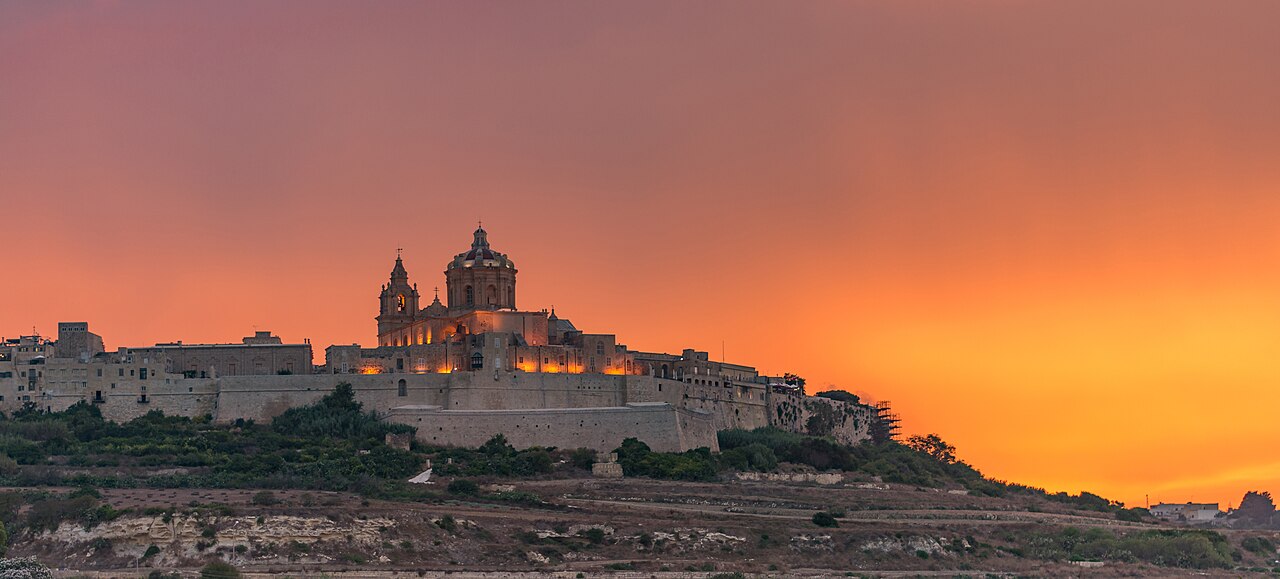
A self-guided audio walking tour of Mdina and Rabat — fifteen stops through Malta’s old capital, from the baroque gate to the painted crypt of St Agatha, in about two and a half hours, with shorter routes built in.
The route
15 stops · 2.3 km · one way, no doubling back
- 01Mdina Gate & the DitchA front door built to be photographed3 min
- 02Vilhena Palace & the Standard TowerHow an island passed a warning along3 min
- 03Villegaignon StreetWhy the streets bend3 min
- 04St Paul's CathedralWhere a shipwrecked prisoner was taken in4 min
- 05The Carmelite PrioryWhere the Maltese rose against Napoleon3 min
- 06Palazzo FalsonA house from before the Knights3 min
- 07Bastion SquareHalf of Malta, from a wall3 min
- 08Mesquita SquareThe medieval quarter, and a television gate3 min
- 09The Greeks GateThe door the city actually used3 min
- 10Howard Gardens & the WallsMdina from below3 min
- 11The Domus RomanaMosaics from the city that was here first3 min
- 12Casa BernardA Rabat palazzo, lived in and open3 min
- 13St Paul's GrottoA cave that changed an island3 min
- 14St Paul's CatacombsThe city of the dead, outside the walls3 min
- 15St Agatha’s Crypt & CatacombsPainted walls underground3 min
Before you set off
- Starts at
- The main gate of Mdina, across the bridge over the ditch. Bus stops and the car parks are on the Rabat side of it, a couple of minutes’ walk away.
- Finishes at
- St Agatha’s crypt and catacombs in Rabat, outside the walls, a few minutes from where the buses leave. The route crosses out of Mdina and does not come back, so there is no walk to retrace.
- Getting there
- Buses from Valletta and from most of the north of the island stop at Rabat, a short level walk from the bridge. Cars are not allowed inside Mdina; the car parks are in Rabat, and the walk in is part of the point.
- Underfoot
- Flat inside the walls, on limestone paving polished by four hundred years of use — the surface is genuinely slippery when wet, which on Malta means the winter. Bastion Square and the Greeks Gate involve a few steps. The catacombs at the end are underground: steep, narrow steps and low headroom.
- Accessibility
- Mdina is small and level and much of this walk can be done on wheels, which is unusual for a walled town. The Greeks Gate and parts of the bastions have steps and cannot. St Paul’s Catacombs are underground and are not accessible; the stop above ground still works without going down.
- Best time
- Early morning or after six in the evening. Between about ten and four Mdina belongs to coach groups, and the streets it is famous for being silent in are not. In the evening the whole town lights by lamp and there is nobody in it.
- People live in Mdina — around three hundred of them. Voices carry a very long way between these walls, particularly at night.
- Almost no shade in Bastion Square or on the bastions, and no shops inside the walls to speak of. Bring water.
- Cafés, toilets and the bus stops are all on the Rabat side of the gate rather than inside.
Tickets on this route
None of these are included in the price of the guide, and none of them are needed to do the walk — every stop is written and narrated from where you stand in the street. This is simply what charges admission if you decide to go in.
- St Paul’s Cathedral and the Cathedral Museum opposite charge admission on one combined ticket.
- Palazzo Falson charges admission.
- The Domus Romana charges admission.
- St Paul’s Catacombs charge admission and are run as a heritage site with its own opening hours.
- The Carmelite Priory museum, Casa Bernard and St Agatha’s crypt and catacombs each charge admission; Casa Bernard and the crypt are seen on guided tours at set times.
Deliberately no prices and no opening hours here. Both change, a page that lists them is wrong within a season, and being wrong about money while you are standing at a ticket desk is worse than saying nothing. Check the site’s own page on the day. Practical notes on this tour last gone over in September 2026.
Threads through this walk
One story, followed across the stops that carry it. Open the walk filtered to a thread and the map keeps only those stops.
- The Great Siege of 1565 · 2 stops hereWalk this thread
- Malta at War, 1940–1943 · 1 stops hereWalk this thread
- Caravaggio, Preti and the Knights’ Painters · 1 stops hereWalk this thread
- The Knights of St John · 4 stops hereWalk this thread
What you get, and what you don’t
Included
- Narration for every stop on the tour, written for headphones and addressed to where you are standing.
- A map that follows you as you walk, with the route traced along real streets rather than drawn straight through buildings.
- The whole thing downloadable before you set off, so it plays with no signal, no data and no roaming.
- Every later version of the tour — added stops, corrections, re-recordings — at no further cost.
- No expiry, no subscription and no app to install. One payment, and it is yours.
Not included
- Admission to anything. Cathedrals, forts and museums charge their own entry, we take no cut of it, and the walk works from the street without going into any of them.
- A person walking with you. Nobody meets you, nobody counts heads, and there is no departure time to be late for. That is the trade.
- Transport to the start, or between the towns. You walk it.
- A human voice. The words are researched and written by a person; the narration is read by a text-to-speech model, and you should know that before paying rather than after.
Feedback
Walked it? Tell us how it went.