Mdina · Malta
Audioguide Mdina und Rabat
Die Stille Stadt, und die römische Stadt vor ihren Mauern
- Stops
- 15
- Narration
- 43 min
- Distance
- 2.3 km
43 minutes of narration and about 41 of walking between stops. Allow 90 minutes to 120 for the whole thing, standing still and looking at it included.
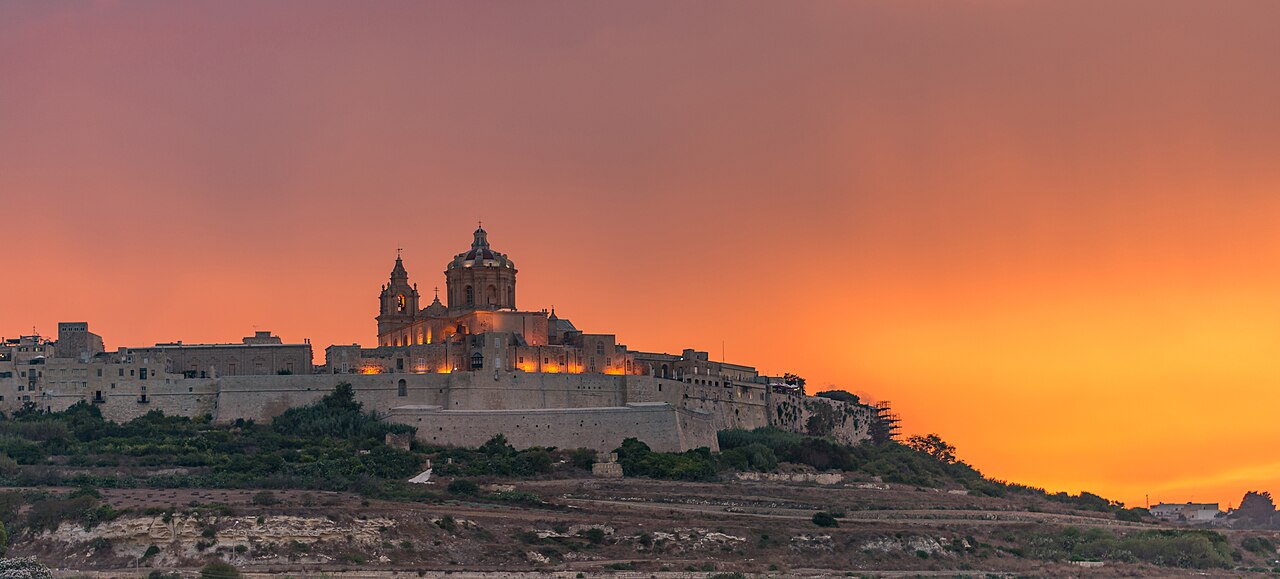
Ein selbstgeführter Audio-Rundgang durch Mdina und Rabat — fünfzehn Stationen durch Maltas alte Hauptstadt, vom barocken Tor bis zur bemalten Krypta der heiligen Agatha, in etwa zweieinhalb Stunden, mit kürzeren Routen zur Auswahl.
Every stop below is free to read in full — the history, what to look at when you get there, and the walk to the next one.
Unlock the full guide and it is read to you instead: hands in pockets, eyes on the city, the map following you from stop to stop, and the whole thing downloaded so it works underground and out of signal.
Start listening at Das Tor von Mdina und der Graben — it plays straight away.
Unlock the full guide — €6.99The route
15 stops · 2.3 km · one way, no doubling backOpen the full map
- 01Das Tor von Mdina und der GrabenEine Haustür, gebaut, um fotografiert zu werden3 min
- 02Vilhena-Palast und StandartenturmWie eine Insel eine Warnung weitergab3 min
- 03Villegaignon StreetWarum die Straßen sich biegen3 min
- 04St. Paul’s CathedralWo ein schiffbrüchiger Gefangener aufgenommen wurde4 min
- 05Das KarmeliterprioratWo die Malteser sich gegen Napoleon erhoben3 min
- 06Palazzo FalsonEin Haus aus der Zeit vor den Rittern3 min
- 07Bastion SquareHalb Malta, von einer Mauer aus3 min
- 08Mesquita SquareDas mittelalterliche Viertel, und ein Fernsehtor3 min
- 09Das GriechentorDie Tür, die die Stadt wirklich benutzte3 min
- 10Howard Gardens und die MauernMdina von unten3 min
- 11Die Domus RomanaMosaiken aus der Stadt, die zuerst hier war3 min
- 12Casa BernardEin Palazzo in Rabat, bewohnt und geöffnet3 min
- 13Die PaulusgrotteEine Höhle, die eine Insel veränderte3 min
- 14Die Paulus-KatakombenDie Stadt der Toten, vor den Mauern3 min
- 15Krypta und Katakomben der heiligen AgathaBemalte Wände unter der Erde3 min
Before you set off
- Starts at
- Das Haupttor von Mdina, über die Brücke über den Graben. Bushaltestellen und Parkplätze liegen auf der Rabat-Seite, ein paar Gehminuten entfernt.
- Finishes at
- Die Krypta und Katakomben der heiligen Agatha in Rabat, außerhalb der Mauern, wenige Minuten von den Bushaltestellen. Die Route führt aus Mdina hinaus und nicht zurück, es gibt also keinen Weg zurückzugehen.
- Getting there
- Busse aus Valletta und aus dem größten Teil des Nordens der Insel halten in Rabat, einen kurzen ebenen Fußweg von der Brücke entfernt. Autos dürfen nicht nach Mdina hinein; die Parkplätze liegen in Rabat, und der Weg hinein gehört dazu.
- Underfoot
- Eben innerhalb der Mauern, auf Kalksteinpflaster, das vierhundert Jahre Gebrauch poliert haben: die Oberfläche ist bei Nässe wirklich rutschig, was auf Malta den Winter bedeutet. Bastion Square und das Griechentor haben ein paar Stufen. Die Katakomben am Ende liegen unter der Erde: steile, enge Stufen und wenig Kopfraum.
- Accessibility
- Mdina ist klein und eben, und ein großer Teil dieses Spaziergangs lässt sich auf Rädern machen, was für eine ummauerte Stadt ungewöhnlich ist. Das Griechentor und Teile der Bastionen haben Stufen und gehen nicht. Die Paulus-Katakomben liegen unter der Erde und sind nicht barrierefrei; die Station oben funktioniert auch ohne Abstieg.
- Best time
- Früh am Morgen oder nach sechs Uhr abends. Zwischen etwa zehn und vier gehört Mdina den Reisebusgruppen, und die Straßen, die für ihre Stille berühmt sind, sind es dann nicht. Am Abend leuchtet die ganze Stadt im Laternenlicht, und niemand ist da.
- In Mdina leben Menschen, rund dreihundert. Stimmen tragen zwischen diesen Mauern sehr weit, besonders nachts.
- Fast kein Schatten auf dem Bastion Square oder den Bastionen, und innerhalb der Mauern kaum Läden. Nehmen Sie Wasser mit.
- Cafés, Toiletten und Bushaltestellen liegen alle auf der Rabat-Seite des Tors, nicht innen.
Tickets on this route
None of these are included in the price of the guide, and none of them are needed to do the walk — every stop is written and narrated from where you stand in the street. This is simply what charges admission if you decide to go in.
- St. Paul’s Cathedral und das Kathedralmuseum gegenüber verlangen Eintritt mit einem Kombiticket.
- Der Palazzo Falson verlangt Eintritt.
- Die Domus Romana verlangt Eintritt.
- Die Paulus-Katakomben verlangen Eintritt und werden als Denkmalstätte mit eigenen Öffnungszeiten betrieben.
- Das Museum des Karmeliterpriorats, Casa Bernard sowie Krypta und Katakomben der heiligen Agatha verlangen jeweils Eintritt; Casa Bernard und die Krypta werden in Führungen zu festen Zeiten gezeigt.
Deliberately no prices and no opening hours here. Both change, a page that lists them is wrong within a season, and being wrong about money while you are standing at a ticket desk is worse than saying nothing. Check the site's own page on the day. Practical notes on this tour last gone over in September 2026.
Threads through this walk
One story, followed across the stops that carry it. Open the walk filtered to a thread and the map keeps only those stops.
- The Great Siege of 1565 · 2 stops hereWalk this thread
- Malta at War, 1940–1943 · 1 stops hereWalk this thread
- Caravaggio, Preti and the Knights’ Painters · 1 stops hereWalk this thread
- The Knights of St John · 4 stops hereWalk this thread
What you get, and what you don’t
Included
- Narration for every stop on the tour, written for headphones and addressed to where you are standing.
- A map that follows you as you walk, with the route traced along real streets rather than drawn straight through buildings.
- The whole thing downloadable before you set off, so it plays with no signal, no data and no roaming.
- Every later version of the tour — added stops, corrections, re-recordings — at no further cost.
- No expiry, no subscription and no app to install. One payment, and it is yours.
Not included
- Admission to anything. Cathedrals, forts and museums charge their own entry, we take no cut of it, and the walk works from the street without going into any of them.
- A person walking with you. Nobody meets you, nobody counts heads, and there is no departure time to be late for. That is the trade.
- Transport to the start, or between the towns. You walk it.
- A human voice. The words are researched and written by a person; the narration is read by a text-to-speech model, and you should know that before paying rather than after.